Mission watch / 9 November 2026
How Earth helped send two ESCAPADE probes to Mars
Two close approaches to Earth have sent the twin spacecraft towards Mars, where their separation will become one of the mission’s most valuable instruments.
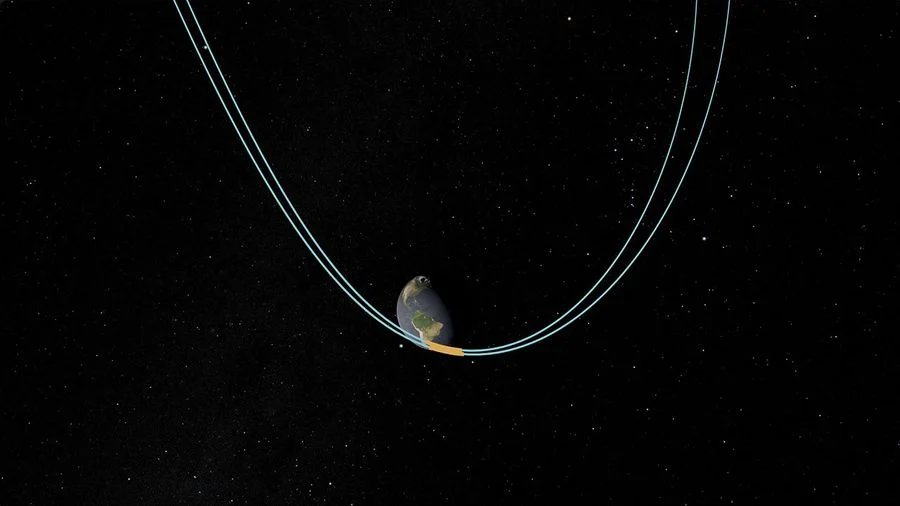
Two departures from one planet
NASA confirmed on 9 November that both spacecraft had completed a powered flyby of Earth. Each approached a moving planet, followed a path bent by its gravity and fired its engine near closest approach. The combined manoeuvre put each probe on a course towards Mars.
There is a useful distinction between trajectory and destination here. A successful departure establishes the path for the cruise. Later correction burns refine the arrival, when another engine firing must slow each spacecraft enough for Mars to capture it.
The problem with a single measurement
Imagine a spacecraft crossing a region where a magnetic field suddenly weakens. The field may have changed everywhere while the spacecraft was measuring it. Or the field may be steady, with a weaker region along the spacecraft’s path. One measurement can fit both explanations.
ESCAPADE will approach this question with a pair of observers. Measurements from different positions and times can help investigators distinguish a passing disturbance from a persistent feature as the solar wind encounters Mars.
What happens between Earth and Mars
The instruments have already had an opportunity to observe Earth’s magnetotail, the extended region on the side facing away from the Sun. During cruise the probes can also measure solar-wind conditions between the two planets.
At the time of NASA’s flyby report, arrival was targeted for September 2027. Capture and science operations are separate milestones: the team planned several months of orbital adjustments before the first science formation. The target for science operations in that plan was June 2028.